The Ref Stop

GK Fouls Attacker

Donate to RefChat

Help keep RefChat running, any donation would be appreciated

NOVARef

Active Member
I had an attacker 1 on 1 with the keeper. The keeper comes flying out and fouls the attacker/wipes her out going for the ball. I'm like OK. What did I just see? What am I going to do? All of a sudden I see the ball trickle into the goal. I award the goal and no sanction. Not a peep from coaches or parents. I felt good. At half time, I talked it over with my ARs and one of the ARs thought I should have cautioned. I got home and I read the law and I think I'm right not to caution since I did not award a penalty kick. If the ball would have went wide, I would have gave the penalty kick and cautioned the GK for DOGSO. (down graded from red because of PK and foul was challenging for the ball.) Do you agree? Below is from the good book for cautioning for USB which would apply to my case. Thanks
  • denies an opponent an obvious goal-scoring opportunity by committing an offence which was an attempt to play the ball or a challenge for the ball and the referee awards a penalty kick
 
The Ref Stop
If the referee plays the advantage for an offence for which a caution/sending-off would have been issued had play been stopped, this caution/sending-off must be issued when the ball is next out of play. However, if the offence was denying the opposing team an obvious goal-scoring opportunity the player is cautioned for unsporting behaviour; if the offence was interfering with or stopping a promising attack, the player is not cautioned
Your AR was correct. Law 12 states the above.
 
But, because a goal was scored, wouldn't we ignore DOGSO as a criteria and just look at it as a "common" foul that we played advantage for?
No. If the offence would have been DOGSO a caution should be awarded for unsporting behaviour.

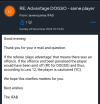
Screenshot_20250310-203806.png

I've asked a question around this before, a debate around a different clip and this is what IFAB said.
 
Thank you, but let's say I did not play advantage, then it would have been DOGSO and it would have been a YC and a PK, not a RC as in IFAB's response. So IFAB's response was about the advantage being the reason to downgrade the RC to a YC, but in my case, the offense would have been a YC since a PK would have been awarded (and the keeper challenged for the ball). Doesn't this change the situation IFAB responded to?
 
Thank you, but let's say I did not play advantage, then it would have been DOGSO and it would have been a YC and a PK, not a RC as in IFAB's response. So IFAB's response was about the advantage being the reason to downgrade the RC to a YC, but in my case, the offense would have been a YC since a PK would have been awarded (and the keeper challenged for the ball). Doesn't this change the situation IFAB responded to?
I dont really see a debate here..


If the referee plays the advantage for an offence for which a caution/sending-off would have been issued had play been stopped, this caution/sending-off must be issued when the ball is next out of play.

However, if the offence was denying the opposing team an obvious goal-scoring opportunity the player is cautioned for unsporting behaviour; if the offence was interfering with or stopping a promising attack, the player is not cautioned

Where does it say that if it's a DOGSO yellow its downgraded to nothing? It doesn't. It specifically makes that provision for SPA which you have said yourself this is not.
 
hi
Two considerations here
1. Description say “wipes her out” which suggests a reckless challenge which is a caution even if advantage is played
2. As it was a potential DOGSO you are correct that it would have been a penalty kick and a caution had play been stopped. It makes little equity that it would be a caution if a goal was scored and a caution if no goal was scored. Back in 15/16 a referee was given discretion on a DOGSO red card advantage with a goal scored in that the law stated that the player may be cautioned. Perhaps IFAB wants the caution either way hence the wording. I think though it may be more aimed at the cynical handling on the line that fails to stop the goal.
Fwiw I would say that a referee could opine no DOGSO as the goal was scored
 
  • Like
Reactions: one
I think the issue here is that @NOVARef thinks a downgrade of a would be red to yellow, implies a downgrade of a would be yellow to nothing. Though it is understandable, It is not the case.
Yep. I can see the logic. The other point I guess is it's only a downgrade IF a PK is awarded, so technically, as a PK wasn't awarded it's still a red card offence that's occurred downgraded to yellow by the advantage.
 
Yep. I can see the logic. The other point I guess is it's only a downgrade IF a PK is awarded, so technically, as a PK wasn't awarded it's still a red card offence that's occurred downgraded to yellow by the advantage.
At the risk if making this unnecessarily complex, wouldn't you say awarding a goal is bigger than awarding a penalty so a bigger downgrade implies? Put that on top of thee advantage downgrade and we end up way in the green zone in terms of sanction. 🤣

My head hurts thinking about it.
 
At the risk if making this unnecessarily complex, wouldn't you say awarding a goal is bigger than awarding a penalty so a bigger downgrade implies? Put that on top of thee advantage downgrade and we end up way in the green zone in terms of sanction. 🤣

My head hurts thinking about it.
Agree that is possibly what the Law should be in this scenario (save for reckless/SFP etc.) Alas we can't MIUAWGA (new abbr.: Make it up as we go along) with the exception of the very rare spirit of the game scenarios.
 
  • Love
Reactions: one
Thanks for all the help thinking this through....I guess one of the issues I was having was linking the advantage section with the USB section. The advantage sections says...

If the referee plays the advantage for an offence for which a caution/sending-off would have been issued had play been stopped, this caution/sending-off must be issued when the ball is next out of play.

However, if the offence was denying the opposing team an obvious goal-scoring opportunity the player is cautioned for unsporting behaviour; if the offence was interfering with or stopping a promising attack, the player is not cautioned

But yet under cautions for Unsporting Behavior, the law says this...

denies an opponent an obvious goal-scoring opportunity by committing an offence which was an attempt to play the ball or a challenge for the ball and the referee awards a penalty kick.

So I was thinking that, if there is no PK (goal must be scored), there is no caution, but then I just mentally brought the play out of the penalty area. If an attacker is 1 on 1 with a defender and this defender fouls the attacker and it's a clear DOGSO, but then say the attacker's teammate gets to the ball and is in on the keeper, and you play advantage and the teammate scores, you would award the goal and come back and caution the defender, so I guess there's no difference here. Thanks again.
 
We had this debate a couple of weeks ago on a different refereeing forum I frequent.
In this case, the "offender" wasn't the GK and the challenge (for the ball) was only careless. The ref (rather daftly) plays advantage after he sees the ball rolling towards an attacker who has a clear shot at goal which the GK saves for a corner. The question was: "Should I still have cautioned for the careless challenge (which would have been DOGSO)"?
My answer was "No" because you played advantage and didn't award a penalty".
He then produced something from IFAB which stated that in these circumstances, a caution should still have applied!! :rolleyes:
My rebuttal was something along the lines of "You're gonna have difficulty selling a caution for a careless challenge when you haven't awarded the penalty!"

(I may also have said something non-complimentary about the state of the LOTG these days).
 
We had this debate a couple of weeks ago on a different refereeing forum I frequent.
In this case, the "offender" wasn't the GK and the challenge (for the ball) was only careless. The ref (rather daftly) plays advantage after he sees the ball rolling towards an attacker who has a clear shot at goal which the GK saves for a corner. The question was: "Should I still have cautioned for the careless challenge (which would have been DOGSO)"?
My answer was "No" because you played advantage and didn't award a penalty".
He then produced something from IFAB which stated that in these circumstances, a caution should still have applied!! :rolleyes:
My rebuttal was something along the lines of "You're gonna have difficulty selling a caution for a careless challenge when you haven't awarded the penalty!"

(I may also have said something non-complimentary about the state of the LOTG these days).
Playing the advantage was the error here. And that error is what's going to make the final decision hard to sell. Not cautioning would be a second mistake, even worse if the reason for it is to make the decision easy to sell.


How IFAB categorised the caution in different sections of the law is confusing.

denies an opponent an obvious goal-scoring opportunity by committing an offence which was an attempt to play the ball or a challenge for the ball and the referee awards a penalty kick.
This just says, under these conditions it is a caution. It does not mean or say if a penalty kick is not awarded, it will not be a caution. It can be, under the conditions explained in the Advantage section of law 12.
 
Playing the advantage was the error here. And that error is what's going to make the final decision hard to sell. Not cautioning would be a second mistake, even worse if the reason for it is to make the decision easy to sell.


How IFAB categorised the caution in different sections of the law is confusing.


This just says, under these conditions it is a caution. It does not mean or say if a penalty kick is not awarded, it will not be a caution. It can be, under the conditions explained in the Advantage section of law 12.
My point exactly. Never ever ever play advantage in the penalty area (unless the ball is rolling into an empty net).

I read the bit from the LOTG that you've quoted and came to the (I thought) logical conclusion that because the penalty wasn't awarded, it doesn't apply. To be fair it does say "blah blah blah AND the referee awards a penalty kick". ;)
 
Back
Top